Setting up a home theater is exciting, until you realize how much difference speakers make. The wrong choice leaves you squinting at dialogue or regretting the cash spent. Whether you’re retrofitting a basement, carving out a media room in your spare bedroom, or starting from scratch, picking the right home theater speakers comes down to understanding your room’s acoustics, your budget, and what kind of performance you actually need. This guide walks through the specifics: what separates a solid speaker from mediocre, where to get real performance without very costly, and how to install them so they actually sound good in your space.
Table of Contents
ToggleKey Takeaways
- Top home theater speakers share critical traits: frequency response (40 Hz–20,000 Hz), impedance matching (8 ohms), directional clarity, rigid cabinet construction, and quality drivers that minimize distortion.
- Budget-friendly options like ELAC UniFi Reference and Polk Monitor series deliver solid performance under $300 per pair without requiring expensive amplification or dedicated furniture setups.
- Premium home theater speakers ($500–$1,500 per pair) justify their cost through engineered precision, metal-braced tweeters, and waveguide designs that expand the listening sweet spot beyond the center seat.
- Room acoustics matter more than speaker price: measure hard surfaces (drywall, tile) versus soft materials (carpet, drapes) to choose speakers that balance your space’s reflections and absorption.
- Proper speaker placement—including center channel positioning 24 inches above or below ear level and tweeter height alignment—often outperforms expensive drivers placed poorly in your room.
- Allow 24–48 hours for speaker break-in and use your AV receiver’s calibration microphone before critical listening to optimize levels and distances automatically.
What Makes A Great Home Theater Speaker
Great home theater speakers share a handful of non-negotiable traits. First, frequency response, the range of low and high frequencies they reproduce. A decent home theater speaker should handle 40 Hz to 20,000 Hz: anything below 40 Hz is usually left to a dedicated subwoofer. Second, impedance matching: most home theater speakers are rated at 8 ohms, which pairs safely with standard AV receivers. Check your receiver’s specs before buying.
Third: directional clarity. Center channel speakers, which handle most dialogue, should have a tweeter (high-frequency driver) positioned at ear level when you’re seated, typically 24 inches or so above or below the TV. Tweeters that point sideways create dead zones, wasted money. Fourth, cabinet construction matters. A rigid cabinet with internal bracing doesn’t vibrate and color the sound. Cheap particle board flexes and adds distortion.
Finally, driver quality and size. A 1-inch tweeter is entry-level: 1.25-inch or larger gives you better detail and smoother highs. For midrange and woofers, bigger drivers move more air with less effort, meaning lower distortion at moderate volumes. Don’t assume expensive = better: a well-designed 5-inch driver often outperforms a poorly designed 6.5-inch one.
Best Budget-Friendly Home Theater Speakers
If you’re shopping under $300 per pair for left, center, and right channels, avoid the temptation to buy a cheap surround system from a big-box electronics store. Instead, look for 2.5-way or 3-way designs (meaning separate tweeter, midrange, and woofer) in a compact cabinet. ELAC and Polk Audio dominate this tier, both offer passively powered speakers (you run speaker wire directly from your receiver, no amp required).
The ELAC UniFi Reference series delivers genuine 40 Hz low-end extension without bloat, and the center channel has excellent dialogue clarity. Polk’s Monitor series hits similar targets at a slightly lower price point. Both brands offer compact bookshelves that don’t demand a dedicated furniture setup.
Don’t skimp on the subwoofer. A budget subwoofer under $200 from SVS (their SB-1000 Pro is around $400, worth stretching for) or Klipsch will outperform cobbling in a cheap 8-inch box. A good sub handles the lifting below 80 Hz, letting your main speakers breathe.
Premium Home Theater Speaker Systems
Step into the $500–$1,500 per-pair range, and you’re paying for engineering precision. Brands like KEF, Naim, B&W, and Paradigm dominate premium segments. KEF’s R3 and Paradigm’s Monitor SE series offer metal-braced tweeters and wave-guide designs that expand the sweet spot beyond the center seat, useful if your couch has three people instead of one.
Premium doesn’t always mean larger cabinets. KEF’s R3 is compact but ships with passive crossovers tuned so that tweeter, midrange, and woofer integrate seamlessly. You’re paying for that integration. Towers (floor-standing speakers) in this range often include dual woofers or 2.5-way designs and can anchor a room without needing additional surrounds for many smaller spaces.
High-end systems above $1,500 per pair introduce active electronics: built-in amplifiers, digital crossovers, and room correction. Speakers like Dynaudio’s Xeo and KEF’s LS50 Wireless II handle their own internal DSP, reducing complexity in your AV setup. These are genuinely engineered pieces, not just expensive wood boxes. According to recent reviews of premium audio systems, top-tier speakers often justify cost through durability and resale value, not just sound quality.
How To Choose The Right Speakers For Your Space
Room size dictates speaker scale and power requirements. A 12 ft × 15 ft bedroom theater is different from a 20 ft × 25 ft basement. Smaller rooms benefit from compact bookshelves paired with a modest subwoofer: larger spaces often need towers or multiple surrounds. Listen before you buy, almost every quality speaker manufacturer has dealers who can demo in a controlled environment.
Measure your room’s hard surfaces: drywall, tile, glass. Hard materials reflect sound and cause boomy bass and muddy midrange. Soft materials (carpet, curtains, upholstered furniture) absorb sound. If your space is 80% drywall and tile, you’ll need speakers that lean slightly bright to cut through reflections. If it’s heavily carpeted with drapes, choose speakers with a warmer tilt.
Consider your listening height and distance. If you sit 10 feet away, a 3-inch woofer on a bookshelf may not pressure the room enough. If you sit 8 feet away in a smaller space, bookshelves are perfect. Mount center channels at 24 inches above or below ear level, that’s your baseline. Speaker placement is discussed further below, but measure first, buy second.
Almost every audio expert recommends testing soundbars and speakers in showrooms before committing to a full system. Your ears, your room, your taste, no review can replace that.
Installation And Placement Tips
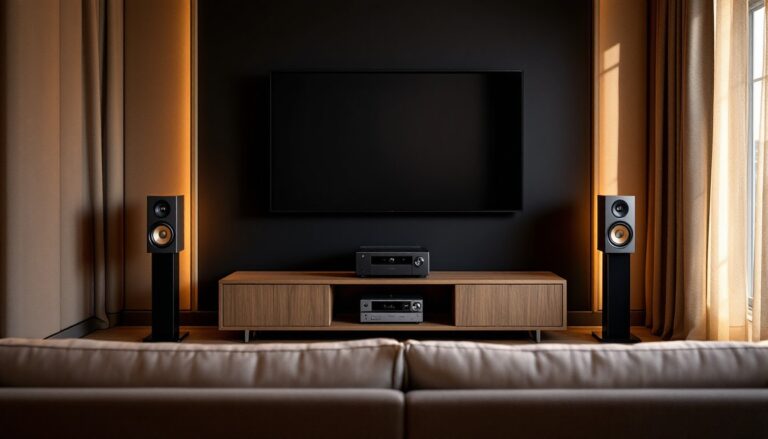
Before wiring anything, measure and map your space on paper. Mark TV location, seating positions, ideal speaker placement, and cable runs. Use speaker stands for bookshelves (never sit them directly on cabinets unless the cabinet is rated for speaker weight), and position them at tweeter height when people are seated.
Run speaker cables behind walls if possible. If not, use in-wall-rated cable and conceal it along baseboards or under carpet (running cables under high-traffic areas risks crushing and short circuits, don’t do it). Keep speaker cables away from AC power cords: interference is rare but possible, and it’s a two-second fix to route them separately.
Center your center channel speaker directly above or below the TV. This is non-negotiable, it handles 60% of dialogue and effects. Left and right main speakers go 8–10 feet apart, positioned at ear level when seated. Surrounds mount 1–2 feet above ear height on side or rear walls.
Let new speakers break in for 24–48 hours before critical listening. Fresh components sound tight and slightly harsh. This is normal. Also, use your AV receiver’s calibration microphone (most modern receivers include one) to set levels and distances automatically. Start there, then fine-tune by ear. According to home improvement and product testing resources, proper placement often matters more than spending extra on pricier drivers, a well-placed $200 speaker outperforms a poorly positioned $500 one.
Conclusion
Choosing home theater speakers is about matching performance to your space and ears, not chasing brand names or the highest price tag. Start with honest assessment: room size, budget, and your listening priorities (dialogue clarity? music balance? dynamic impact?). Buy passively powered bookshelves and a good subwoofer, place them thoughtfully, and let your ears adjust. You’re building something that lasts 10+ years. Rushing the decision rarely ends well.